|
"Read Don’t Play
'64"
RAR NOTE:
I couldn't resist the headline riff above on a song title - "Walk
Don't Run '64" - that captures the context of the Doug Strobel piece
below. Doug's recollections are of a time capsule nature, harking
back to a time when "we" Baby Boomer types were just becoming
inspired to "play", in the musical sense. There were just a handful
of record companies and teenagers bought "singles" and learned about
their recording heroes by devouring, in the intellectual sense of
course, the pages of music magazines - Cashbox, Billboard and
later Crawdaddy!, Creem, and Rolling Stone in the U.S., and
Melody Maker, New Musical Express (NME) or Mersey Beat
in the U.K. People were carefully reading the liner notes on
albums, and a whole lot more of us were pouring through the Tiger
Beat (premiered in 1965) and The Beatles special magazines that
seemed to hit the stores weekly. On the other hand, some of the more
precocious among us actually went to the library to get a little
more in depth information about music beyond the jangle of the
pop-rock on your parent's AM car radio. Here Mr. Strobel shares his
experience with learning music starting with the letter "A".

By Douglas Strobel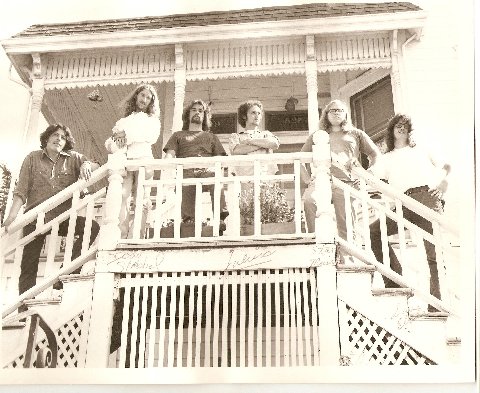
PART I:
Libraries, Letters and Liner Notes
Before
I could play music I could read.
And I did.
I found I enjoyed reading about music.
So I did it.
I was hungry for information, insight
into the inhabitants of a seemingly alien world; much of it originally
focused around what was called the “British Invasion” (early to middle
‘60’s)
Album covers were generally a “tease”
as the sensibility was more often “anti information” (Eric’s favorite
colour is blue…).
Album art design got “hipper” and the
“buy this record, you’ll love it” blurbs were dispensed with. In fact
album art became a “scorched earth” kind of hip: nothing left but a
picture & song titles.
I was “forced” to read composer &
production credits.
Can you spell serendipity?
Bob Dylan soon filled the breach by
going “one better” in artiness by filling his album sleeves (even an
additional printed inner sheet) w/prose.
These tongue in cheek ramblings (?)
were “interesting” (as in the Chinese curse) but secondary to the
offerings etched in vinyl. Still I thank him for a number of allusions
to “important artists” “Ma Rainey & Beethoven once unwrapped a bedroll…”
There were “clues” everywhere if only
one could follow the threads of this “beat” scavenger hunt. In the days
before the information super highway printed matter (often in book form)
was the way to pursue these bread crumbs. I am grateful to folklorists,
biographers, music critics, et al for their care & attention to detail.
Local radio (A.M.!) published
newsletter type “fanzines” to keep us up to date w/the antics of the “on
air” personalities…(This is pre Rolling Stone magazine)
While reading the KYA or KFRC fanzine I
got a couple of solid pieces of information. These nuggets spurred me to
“acts of intention” that were life changing!
I read that the Rolling Stones named
themselves after a Muddy Waters song & in the same article I read the
name Leadbelly!!
I was drawn to these initially by the
very “otherness” of the names of these performers. These artists had not
placed songs on the Top 40 in N Ca so I had not heard them directly.
In a matter of a few days I returned
from the local library w/The Best of Muddy Waters (no overstatement
this) on Chess & a Leadbelly record. (Folkways)
During this period I also had read the
names & the pedigree of The Hot 5’s (Louis Armstrong & Co) & JellyRoll
Morton. No one in my acquaintance had a cool name like jellyroll & while
I didn’t know what it meant I thought I could recognize cool…. I got the
Hot Five disc with weirdly “posed” cover & New Orleans Memories (Jelly
Roll Morton) from the library over the next few weeks/months.
There was no turning back after hearing
this music. I have never recovered. I didn’t always “get it” right away
but it “got” me.
I was hanging out w/some older guys &
was also being given some very direct input re: what was “good” music. I
was offered a lifetime of names of performers, song titles by people who
could play & who spoke w/certainty about what was what & who was “hip” &
therefore worth listening to.
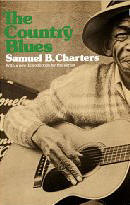 Samuel
Charters had a pioneering book published in 1959: The Country Blues.
This guy had his fingers in a lot of cool musical stuff & along w/his
wife Ann they discovered, documented, promoted, produced, recorded &
photographed artists as diverse as The Jim Kweskin Jug Band & Joseph
Spence (hint: those are your “clues”) There were few outlets & a fierce
but small audience for a publication such as this so my hat goes off to
DaCapo Paperbacks for publishing this seminal work & seeing fit to keep
it in print. Samuel
Charters had a pioneering book published in 1959: The Country Blues.
This guy had his fingers in a lot of cool musical stuff & along w/his
wife Ann they discovered, documented, promoted, produced, recorded &
photographed artists as diverse as The Jim Kweskin Jug Band & Joseph
Spence (hint: those are your “clues”) There were few outlets & a fierce
but small audience for a publication such as this so my hat goes off to
DaCapo Paperbacks for publishing this seminal work & seeing fit to keep
it in print.
The Country Blues offered an overview
of the music via bios of 12+ key players in this genre. Many of these
artists remained unknown to me, aurally, for some years as recordings
were pricey & scarce in my immediate environment. The local libraries
wealth of resources took some time to understand & appreciate. My
friends, The Albright’s had some discs but they also could play so I was
torn between listening & watching.
The music called “country blues” were
primarily solo, acoustic performances by male performers from the early
to late ‘20’s. The sobriquet “country blues” was developed to
distinguish the music from the very popular “classic blues” of Ma
Rainey, Bessie Smith, et al. Charters wrote with affection, sincerity, &
the passion of a true believer. He made the music seem important &
vital. The performances discussed took on the air of “holy grail” & gave
the music a kind of “stamp” of authenticity. There was art work from
“sell sheets” & advertisements by the record companies included in the
book. The artwork was fascinating & very politically un correct by
today’s standards but intriguing nonetheless.
I also read a couple of rock & roll
“trivia” books that offered a surprising amount of factual “glue” or
“cultural velcro” & opened up other areas of interest….songwriters,
studio musicians, producers, arrangers, recording studios, specific
session anecdotes that are amusing & enlightening.
Biographies, by definition, tell the
story of a life. LIFE is not simple or as straightforward as one might
hope & reading some biographical offerings was frustrating as the author
had his/her own axe to grind & neglected what I wanted to know about in
their book.
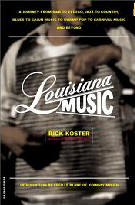 I
have read hundreds of books about every aspect of music: field
recording, autobiographies, critical works on songwriters, singers.
Biographies on record producers & record companies. The history of WLS
radio, Nashville’s Music Row & The Louisiana Hayride, The Grand
Ole’Opry, recording studios & my most recent “Louisiana Music” by Rick
Koster. (DaCapo Press) I
have read hundreds of books about every aspect of music: field
recording, autobiographies, critical works on songwriters, singers.
Biographies on record producers & record companies. The history of WLS
radio, Nashville’s Music Row & The Louisiana Hayride, The Grand
Ole’Opry, recording studios & my most recent “Louisiana Music” by Rick
Koster. (DaCapo Press)
Louisiana has a rich and diverse
musical culture & Mr Koster has done justice to it…a quibble here &
there hardly worth mentioning & nothing that will hurt the story or
distort the message.
Early Jazz, Blues, Rock & Roll , Rhythm
& Blues, Cajun, Zydeco even Hip Hop & Classical musicians who hail from
Louisiana are given (sometimes brief) bio’s, discographies & personal
input from a fan who is knowledgeable & passionate in equal parts.
PART II:
Louisiana
The
State of Louisiana is Home to more styles/genres of music than most of
the lower 48 put together.
Early
Jazz, Brass Band/Funeral Parade Bands: including the current
reinvigorated tradition, Cajun, Zydeco, Country, seminal Rock & Roll &
R&B from a couple of recording studios, Swamp Pop, Funk, Mardi Gras
Indians.
The
Piano Tradition alone is staggering: JellyRoll Morton, Professor
Longhair, Dr John, Henry Butler, Allen Toussaint, James Booker
New Orleans’ own Louis Armstrong influenced every musician & singer of
the 20th century regardless of their own “style”.
These
styles are rife with tradition(s) bound in culture(s) of the people who
live there and the traceable traditions of the places they came from.
The geography plays an important role: most of New Orleans is below sea
level & caused a burial tradition unique to the area.
New
Orleans was a “mustering out” point for Civil War veterans & many band
instruments were abandoned as ex-soldiers “beat feet” to get home.
The
French, Spanish & Caribbean influences combined with the Catholic Church
& the institution of Slavery all contributed to the rich, diverse
cultural traditions that are ultimately expressed in the Music.
“Louisiana Music” by Rick Koster is an astonishingly cogent peek into
the many styles as well as practitioners of said styles.
This
guy knows his stuff & loves the music & wants to share the joy & wonder
of “it” with us.
He
even references the worlds of Classical & Hip Hop as it pertains to the
state. Once again DaCapo Press steps up & supports a writer whose
mission is slightly left of main stream.
I have
read lots of books, articles, album notes about the various styles Mr.
Koster covers. He manages to find new “stuff” to talk about & tells the
old reliable stories well. Both the novice & the seasoned reader will be
enlightened after enjoying this missive.
I was
familiar with much of the music, if not all of the players.
He
speaks with insight about the traditions & offers a number of
“travelogues” throughout the region.
The
technology of c.d.’s spawned a huge re-issue market & over the years I
have bought lots of discs. I can generally read about an artist & go to
my collection & hear the cut being discussed.
I
decided to use Mr. Koster’s performers references in a “new school” way.
When he mentioned Amede Ardoin or Joe Falcon (both
early recording artists in the Cajun tradition) I went to my web browser
& typed the names into YouTube! Thanks to obsessive cyber oriented fans
I got to hear a lot of music I did not have in my collection. The
section to the right of the primary video is called “related videos” &
by perusing these it is possible to get a fairly good “aural”
representation of a style & a pretty complete cast of practitioners.
The
cast of characters of Cajun/Zydeco Tradition alone is immense & so far I
haven’t been able to “stump” YouTube. I am impressed!
There
are several video features on this music that are “snippets” of longer
documentaries & contain a lot “in situ” footage showing small Louisiana
towns where the traditions are still in place & “prospering” as well as
hearing some eccentric performers talk about their life & times in a
world that has almost passed us by.
You
can reference any of these styles via specific performers & access the
music on YouTube.
JellyRoll Morton, Dr John, Kermit Ruffin, Louis Armstrong, Moon Mulican,
The Hackberry Ramblers, Fats Domino, Allen Toussaint, Professor
Longhair…I am excited that you might be finding this wonderful music for
the first time….
Pax
Douglas Strobel
|