|

►Original
Musical Compositions and Select Covers
►Fiction
and Non-Fiction
►Special
Projects
►Essays
| |

ESSAY
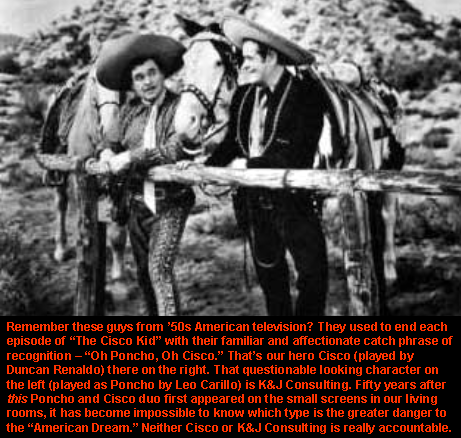 Oh
Poncho... Oh
Poncho...
Oh
Cisco! You Are A Villain?
Do
you ever feel like somehow you got selected to be one of those people things
"happen to?" Not necessarily good things, not things that happen "for you." It makes all the
difference in life, whether it is a tapestry of joy or a sea of pain. I suppose
we all get to knit and sink, and life's "losers" have stories as
nicked by fate as do life's "winners." That it is usually hard to
perceive the karmic justice - that bad things happen to good
people - only darkens the waters. That in our new age of social and professional
networking we are engaged with strangers only perpetrates the surreal and
increases the likelihood of the unexpected occurring.
Around
the first of the year, I was sitting at my desk in the office of the engineering
company I was working for at the time, when I started getting calls from this
friendly guy named Bill Davis. Here is where the surreal part starts. Bill had
found me on the Internet, where I have a big presence because I'm an Internet
junky. You can learn almost everything there is to know about me on the
Internet, I'm an open book. You can even hear me warble off key, if you've a
mind. 
Bill
told me he had an opportunity for me as a Bid Developer with Cisco Systems. I'm
perfect for the job, he said. It paid $104,000 per year and, among the benefits,
I would work from home.
I
am a California mortgage slave. I not only have to work, I have to make dollars
almost out of the range of an English/Journalism major, even one with 30-plus
years of professional experience. (Having a
certificate in technical writing ups my market value.) Still, I'm
screwed for anything beyond about $4,000 in monthly mortgage-related payments. I
was working for a good firm, one that had made its reputation doing
environmental remediation and cleanup projects. The people were pleasant. It was
the kind of place where I would bring my kids. In fact, one pleasant graphics
person there had Lego sets that "needed to be built," and my son
Griffin would sit in a cubicle and go to town on the construction. One could hardly
hope for a better company, except that they weren't quite paying me enough to
keep me from sliding ever further into debt. It is hard to feel optimistic in an
employment in which you work all the time only to have your fortunes decline. There is that disconnect
again, that surreal aspect of modern life.
Which
brings me back to Bill Davis. Bill, it turned out, is with a Florida company
called K&J Consulting and he told me that his firm has a standing deal with
Cisco Systems to provide technical support, and he needed to fill a Bid Developer
position for his client. He repeated, "It's $104,000 per year..." In
fact, he started playing that drum pretty hard. "$104,000 per year..."
Now
$104,000 per year in California money isn't a great amount, purchasing-power
wise, but it is more
than I was making. Plus, this wasn't just some IT firm Bill Davis was touting,
it was Cisco Systems. Cisco has "rigged" 70 percent of the entire
existing Internet! More importantly to me, they are annually touted as "One
of the 100 Best Companies to Work For in America," maybe even the
best.
I
stalled Bill for awhile, while I thought about making a move. The company I was
working for had just given me a raise, 100 percent of the maximum under their
system of managing pay increases; it more than matched the rate of inflation.
And around Christmas the proposal group treated me to an expensive night out with them at Bing
Crosby's place in Walnut Creek, and they gave me a little gift over dinner. It
was not easy for me to leave these people who had been really good to me, but
Bill Davis was offering better money and "Cisco Systems" on my resume.
He assured me that K&J was in good with Cisco and had maintained a client
relationship for nine years, with no reason for it to stop.
Over
Christmas break I went into San Francisco and met some "Proposal
Experts." That is the name of the group I was being hired into - the
Proposal Experts. The two experts I met with seemed like pleasant guys, which
sort of cinched the deal. I decided I couldn't say no to Bill Davis and his
$104,000, so I called him back to accept the offer, but not after first
confirming what I thought I had understood to be "the deal." It turned out I had
the salary right, but the benefits did not include health insurance. In fact,
they only included expense reimbursement and two weeks paid vacation the first
year.
Without
health insurance, Bill's $104,000 package shrunk significantly, but I felt
confident that we could purchase individual coverage health insurance and still
be money ahead. Besides, my company at the time was offering Great Western
health insurance, which is practically like having no health insurance anyway.
In retrospect, I was lost in heedless optimism regarding the practicality of
buying individual coverage health insurance, but it was part of a broad trend. I
was headed into the weird realm of Cisco Systems and their dark underling
K&J Consulting.
But
First, A Message About Our Sponsors...
A
terrible thing has happened to the American Dream. You
remember "the dream?" The central tenant of America's "land of
opportunity" story was that every hard working U.S. citizen (every
"male" citizen, in the original version) would be able to live in a
home of his own, purchased with the sweat of his own brow. Not only could
"Everyman a King" be a basic fact of American life, but every
succeeding generation of Americans could toil with the knowledge that they would
find themselves better off than had been their father's generation.
That
bit of American propaganda was an outgrowth of the second industrial revolution
in the U.S., which evolved in the 1940s as industry geared up to equip the
military with the machinery necessary to defeat Germany and Japan in the second
world war. And, for a time, the dream seemed real. Fueled by the G.I. bill,
veterans returned home to attend college in previously unheard of numbers,
higher education reaching deep into the American social well, and the modern
American corporations rose up as centerpieces of America's unparalleled economic
might. Why, the future was so bright you had to wear sunglasses! Mothers
wished for their children to find secure employment in the powerhouse American
corporations, representing lifetime passes to an upward mobility that had no ceiling. And for
a time the rising tide did seem to lift all boats, and even guys who
weren't able to take advantage of greater access to higher education found
themselves in what felt like lifetime employment with major American
manufacturing concerns. My father, an Air Force-trained electrical specialist
without a college degree, found a job as an electrical engineer in the aerospace
industry, working with the former Martin Marietta and then the Beach Aircraft
corporations. In the late '50s he bought a new brick home in the Denver suburb
of Englewood, Colorado, paying the modest amount of $12,000 as his investment in
the American Dream. But something started to happen in the '60s, a slow sense of
diminishing returns. In 1965, my father fled his little brick suburban
"castle" out of fear that the magic corporations he worked for were
determined to lay him off, and he retreated into the American backwaters, never
again to benefit from the optimism he had felt around America's unstoppable
economic might. He ended up doing well for himself, rising to senior executive
levels in the banking industry, though now approaching 80 years of age he is
still in the workforce selling real estate. Absolutely dedicated to the values
of hard work and honesty, and stubbornly resistant to any notion that there is
anything wrong with the heart of American "business," he has been laid
off in a corporate takeover, and forced into early retirement by another
corporation that he devoted himself tirelessly to for 20 years; though of course
it wasn't really a "retirement," it was just a lightening of their
payroll, a "youthing" of the company. After nearly 60 years in the
workforce, he still doesn't have the means to rest.
America
stalled in the late '60s, when growth in purchasing power stagnated and then
started going backwards. This month the Associated Press reported that there has
been "a 12.5 percent drop between 1974 and 2004" in median annual
incomes as adjusted for inflation (this from the findings of the Pew Charitable
Trusts' Economic Mobility Project). Household incomes rose in that period, but
the reason is increased numbers of full-time working women. As we all know,
American women, who during WWII entered the workforce out of patriotic duty have
stayed in the workforce because 60 years later it takes two incomes to support a
family of four. The impact on American family life, from having parents diverted
from the roles they need to accept to build healthy families, is completely
calculable. We see it in falling high school test scores and graduation rates,
and in the jobs American corporations outsource to educated people from other
nations (who work for less). We see it in the paralysis of our school
administrators, who will not address failing students by confronting parents,
too many of whom are single, poor and uneducated themselves. And we see it in
the number of lawyers who are ready to bring claims against school
administrators for their "mishandling" of student affairs.
Where
we don't see the pain is at the top of the economic ladder. As the idea of
economic mobility withered for the "average" American, the Pew Project
reported that "CEO pay was 262 times the average worker's pay in 2005, up
from 35 times in 1978," this based on their analysis of Congressional
Budget Office statistics.
And in the most direct rebuttal to the idea of an
American dream, the Pew Project reported that citizens of Denmark, Norway,
Finland, Canada, Sweden, Germany and France all have a greater opportunity to
experience upward economic mobility than do citizens of the U.S.
Otherwise put,
the American Dream had to sell its house and is now living in Europe.
Old
Europe, that is.
For
Americans, it is more bleak a picture than perhaps a non-American can imagine.
(There are bleaker pictures, to be sure: we still have illegals coming over the
borders from economically immobile Mexico.) The "social contract" that resides at the
foundation of the American workers' future has not so much been forgotten as circumvented. Sometimes America,
and especially American business, seems like a snake swallowing itself by force of
its own ideals. At the heart of its "ideals" is "free market
capitalism," which essentially empowers corporations to prey on one another
(and their employees),
not only in terms of product market share but in terms of "social
infrastructure." Health Insurance providers, focused on increasing profits
for shareholders, continue to raise costs for corporations to provide health
insurance benefits for their employees. As a result, companies have continued to
increase the deductions on individual pay as companies pick up less and less of
the total cost of the benefit, reducing in real values these companies'
commitments to their workers. Under those predatory pressures, the potency of the social contract decays from the
sides of both employer and employee, while at the same time America's recent
conversion to a "service economy" has made 24/7
responsiveness to clients and customers an imperative. The "expectation bar," on that level, has been raised
to where a company cannot compete unless it promises this extraordinary level of
service delivery.
That's why you can call almost anybody's tech support at all hours of the night, and why Raley's
"honors our veterans on Memorial Day" by closing a whole two hours earlier
than usual.
So
here you have this bind that Americans, and American businesses, find themselves
in. Companies are promising to do more for their clients, less for their
employees. Under that calculation, the new American benefit is that now you can go to McDonald's
anytime, all
night long; it'll be there for you when your overtime shift is finally done, and
it'll probably be all you can afford anyway.
My
Hat is White, Poncho. Why is Yours Grey?
What,
you may ask, has all of this to do with Poncho and the Cisco Kid?
It
has to do with another evolution in American business: the rise of the
"consulting firm." Consultants have, of course, always been around.
They have tended to be people with extra insight into the machinations of
things, people from the executive branches of institutions who have arcane
knowledge that they dispense for a fee, and generally a fee far higher than
would be paid to any employee dispensing the same stuff, were that possible. And
more and more, that is possible because "consultants" aren't
necessarily what they used to be. Certainly the top-end professional mercenaries
still exist, the former government officials, like William Cohen and Colin
Powell. But these days there is a new category of "consultants" who
are not really top-end professionals and don't really "consult" in the
traditional sense of the term; with them "consult" is used as a
marketing term. They are more like specialized temporary workers who
are brought in for defined periods to do specific projects. Working as a writer
or editor, in various capacities (proposal and technical), I have been one of
these types. There are tons of us in the Bay Area. We tend to work long days,
but benefit from getting choice assignments and higher rates of pay. We benefit
companies by providing "surge capacity," as the Defense Department
might say. We provide the extra strength to get a job done, and then we get off
the payroll without further benefit.
I
first became aware of this class of consultant back in the late '80s, when as a
staff member with a corporate training firm I would find myself working with,
usually supporting, some pampered character who would show up seemingly out of
thin air for a period of
time, contribute something, and then leave; usually, it seemed to me, with all
the money. Companies' reliance on these folks tends to diminish the perceived
value in being a "staffer" or an employee, so years ago, unable to
beat them, I became one of them. I have peddled myself to software, hardware,
architecture and engineering, university research, corporate training and
financial services industries, and it had been a great way for me to work,
providing the required level of income and flexibility to allow me to do other
things with my life, like pay attention to my family and pursue creative
pursuits, including this site.
Back
in 2005, with our kids getting to the age where they needed to be in strong
learning environments and in a school system that could provide the foundation
skills they would need to go on to higher educational levels, my wife and I
started looking into buying a home in Benicia, California. There you have one of
the top 50 towns in America to live in, according to Sunset Magazine. To
get the loan to cover a California-sized mortgage, however, I had to make the
choice to take a staff position with an engineering firm. It did not help our
income in any substantive way, but the loan officers at the bank liked that it
looked like stable employment. I took the job and we bought a house.
Soon
enough the old realities set in. My new firm relied heavily on consultants to
come in and run the largest proposals we pursued, and so we would occasionally
"surge" with this extra manpower. One couldn't argue with success, we
won everything we went after. And, as usual, the consultants took all the glory and
left with a lot of the money. Worse, the company's reliance on the consultants
put a cap on how high the rest of us in regular staff positions could rise.
The company owners "trusted" their hired guns (like Cisco and Poncho)
a lot more than they did those of us on staff. Again, a tortured social
contract; a situation akin to preferring the neighbor kid to your own
off-spring.
In
January I gave more than one month's notice to my employer of my intent
to leave my staff position to become a Bid Developer with Cisco Systems, a
"consultant," but not
before confirming the offer one more time. In doing so, I made an error that, in
retrospect, should have been revealing but slipped my attention at the time.
The connection, I learned, between K&J and Cisco is seamless. I at first did
not know if I was talking to a K&J consultant or a Cisco regular, and so
when I sent an email to Bill Davis confirming the salary I copied people who
turned out to be Ciscoans. I immediately got a harsh note back from Bill
Davis telling me not to divulge pay information to anyone at Cisco.
What
was the secret? I wondered.
I
received a contract from K&J Consulting stipulating the terms of our
agreement, including the $104,000 per year salary, and I got a Laurel and Hardy
email welcome
from K&J CEO Ted Davis. Another Davis? I must admit that a favorite movie, The
Adventures of Buckaroo Bonzai: Across the Eighth Dimension, flashed to mind,
in which all of Emil Lizardo's spaced aliens share the same first name, John.
A
few days before I started work, I was informed that I would not be joining the
team I had interviewed with, but rather would be interviewing again with another
Bid Manager as a preface to joining her team. This threw me a little, but I was committed now, and after meeting
the new Bid Manager in a telephone conversation I felt alright with it.
And
yet...
I
Told Them to Go Fuck Themselves
Cisco
Systems essentially sells network systems and they are big on "remote
workers," people who work from their homes. They feature their products,
providing instant messaging and desktop sharing technologies and telephone
conferencing services. It all works pretty well. Cisco people have choices and
they tend to determine which technologies work best for them, and ignore the
rest.
My
next K&J contact came through a telephone orientation. Originally the plan
had been for me to report to the San Jose office for orientation, but the
coordinator decided to just do it over the phone. They shipped a laptop to me
that didn't arrive in time for the orientation call, but no matter. There was a
PowerPoint presentation in email that we barreled through telling us how to do
our invoices and reporting.
I
took a trip down to Cisco's offices in San Jose to "be badged."
Cisco's campus is vast and I was taken by how shabby it looks. The company chose
a new logo for itself in 2006 and maybe they aren't doing maintenance on the old
stuff until the new stuff arrives, but Cisco generally looks like it needs a
coat of paint. The company hasn't got the strongest color palette to begin with
and all the old signs seem faded. I found this oddly disappointing, having
convinced myself that I was signing onto something great with this IT behemoth.
The people I met seemed friendly and fine.
During
the orientation conference call, I spent time chatting with another "new
hire" while we waited for our hostess to get on the line. He turned out to
be a guy like myself, another "proposal expert" who had
years of experience in the architecture & engineering field. Somehow he too had
been discovered and recruited by K&J Consulting, and he was actually in the
slot with the San Francisco team I had initially interviewed with. I lost track
of him after that, but noticed he did not attend the Proposal Experts Offsite in
Vancouver, B.C in March. It turns out he hadn't lasted the first week. The job advertised
itself as an opportunity to work on proposals from remote locations, but both of
us soon discovered that wasn't at all true. "I told them my idea of working
remotely on a proposal is that I take the proposal information I need, go off
and work on it, and then bring it back done," he told me. "That's not
what they want. They want somebody who is sitting there chained to their
telephone 24 hours a day. I told them to go fuck themselves."
Working
With an Un-funded Mandate
|
My
short-lived orientation buddy was not wrong. Cisco's Proposal Experts group is
not truly a group of "proposal experts." He and I and almost everybody
we have worked with over the past dozen years are proposal experts,
though outside of words on a resume none of us would likely call themselves that.
Cisco's Proposal Experts are good at what they do, and they are engaged in
developing proposals, but their role is that of coordinators, or administrative
support. They are not people who are in place to "add value," as
their name would seem to suggest, but rather to support the proposal
process. Possibly for that reason, the Proposal Expert group at Cisco has no funding of its
own. Rather like a temp agency, it relies
on selling its services internally to Cisco account teams, who turn around and
charge the expenses to their own budgets. The
Cisco Intranet is used to make all these Proposal Expert services easy for
account teams to access. It's like "Dial-A-Temp." The Proposal
Experts have even built systems, managed through the Cisco Intranet, that
make it possible for one to "dial up" proposal templates and
"scrubbed" text used in previous proposals (i.e., scrubbed of
language specific to the client it was developed for, and scrubbed of
language that might inadvertently commit Cisco to something unintended). A
great deal of what the Cisco Proposal Experts do, besides engaging and
coordinating the input of contributors, is to retrieve and organize
existing information. |
Cisco's Proposal Experts are good at what they do, and they are engaged in
developing proposals, which curiously are referred to as "deals" at
Cisco, as if arms shipments are being delivered to Contra Rebels out of a back
room. So why aren't they called Cisco "Deal Experts?" It probably sounds too
shady to the Proposal Experts' marketing- savvy managers. |
Focus
On the Competition
Cisco,
in fact, is a firm with a rapacious appetite. They put effective marketing
spin on it, positioning themselves as constantly adding value for their
customers through investments in innovations and the best new technologies, but
in truth they are in a feeding frenzy. The number of employees they boast is
growing robustly through the acquisition of competing firms, until now only two
other companies, Jupiter and Foundry, really keep Cisco from a complete monopoly
on network technology, and Cisco has an aggressive program to do away with them.
Cisco hires former Jupiter and Foundry technical experts to man their "war
rooms," or "Focus on the Competition" (FOCOM) teams. They dissect
Jupiter and Foundry products and advise proposal teams on what needs to be said
to undermine the competition and to build value for Cisco's more expensive line.
These guys are tremendous. They can look at a scope of work in an RFP and devise
a bid that mirrors what the Foundry and Jupiter account managers will likely
offer. All that is required is a sense for what else the competition might offer
to sweeten the deal. The Cisco FOCOM guys know when their competitors will be
releasing their next product, and what weaknesses in their current product line
the next release will address, which influences the way Cisco bids. It is
high-tech hardball and extremely impressive.
What
Cisco struggles with is rapid absorption of these acquired entities, and no
situation typifies that more effectively than Cisco's acquisition of
Scientific-Atlanta (S-A). S-A is the manufacturer of "set-top" boxes
that decode cable television signals and control channel selection. Two years
after Cisco gobbled up S-A, the two companies still are at arms length from one
another. S-A employees behave like a conquered people, barely willing to
acknowledge their Cisco masters. I shadowed a "deal" in which Cisco
and S-A pursued an Internet Protocol Television (IPTV) opportunity in the
Bahamas, which was an S-A account manager's initiative, but for some reason it fell to Cisco's
Proposal Experts team to develop the bid. The engagement team swelled to at
least twice, probably more, the size of a typical "virtual team,"
as Cisco ironically calls them. For every Cisco person there was an analog on
the S-A team, not that the S-A people were going to contribute anything to the
process. One S-A systems engineer provided me with the link to the system they
use to identify hardware required for the scope of work, which translates into
pricing. "Spec-ing a network system" was obviously not something I was qualified to do. The point is,
the S-A people just couldn't muster the will to function under the new Cisco leadership. The proposal, which was run by my supervisor
and functioned for me as a training and
orientation exercise, was one of the worst "joint venture" (not in the
technical, legal sense) type
of proposals I have ever experienced, though "JV's" are generally pretty strange
exercises. This one went so weird that Cisco eventually tendered an offer using S-A hardware and software
from a chief rival, Jupiter. Cisco currently has no end-to-end IPTV solution,
which is what the RFP called for, though software is in development. Cisco
didn't feel comfortable with making a "beachhead" for their new
technology out of S-A's Bahamas deal.
Vancouver
Meltdown
As
one might imagine, with 54,000 employees, most working from remote locations, Cisco is a really
impersonal place beyond tiny pods of traditional office staff who do build
relationships. (I think of them as the "core routers," a Cisco
hangover. Language there is riddled with tech talk. "Do you have the
time?" for instance at Cisco becomes "Do you have
bandwidth?") Once
a year the Cisco Proposal Experts have an off-site in which team members from
across the globe assemble to discuss current initiatives and get to know each
other a little better. This year the event was held over four days in Vancouver,
British Columbia.
The
off-site was going to be the first time I had ever laid eyes on any of my
"fellow experts," including the manager of the Proposal Experts, a
Scandinavian with the unlikely name of "Bent Rye," which in my mind
immediately translated to "Perverted Wheat." Bent is a tall, skinny,
Ichabod Crane type, who is an "excitement seller," which is to say
that his approach is to rev up the energy so that everyone gets excited about
whatever it is he is trying to sell. He and his staff had come up with a theme
for the offsite -
"One World, Right Here, Right Now" - which struck me as
extraordinarily dated, like maybe 10 years ago Bent had heard a Jesus Jones song
that had been metastasizing in his brain as a marketing slogan. The "One
World..." part referenced the Proposal Experts growth around the globe,
particularly in the Asian and European markets.
After
working through technical glitches, Bent showed us a video called "Viking Dawg," which featured him doing some
execrable rap something along the lines of "You've never seen anything like
this before, because there has never been a Proposal Experts before." He
liked it so well that he played it twice, the second time for the benefit of
some invited speakers, Cisco movers and shakers who showed up and struggled to
think of anything to say. None of them seemed to have bothered to prepare
anything, other than thanks for all the hard work. I had the feeling they felt
obligated to fly in for a day, say some stuff, and get out. The agenda was packed,
with one speaker or demonstration after the next, but it soon became apparent
that it was going to be a long four days. The Proposal Experts provided a Yoga
instructor to drop by and show us how to relax and re-energize. I couldn't take
my eyes off Bent Rye, as he tried to duplicate the Yoga movements, looking
something like a stork trying to midwife a delivery.
My
attitude toward the proceedings was colored by having shown up with a "bug." I
wasn't feeling well, but the first night of the conference I joined the experts
at a Moroccan restaurant where we were entertained by a belly dancer who one at
a time pulled conference attendees into her dance. It was fun, but it was the last of
the evening festivities I attended, as I was feeling "sicker" by the
second. I couldn't help but think of the ribald dance fest when on Wednesday
morning the Viking Dawg stunned the conference by announcing that a K&J
consultant had been fired and sent packing after inappropriate behavior at the
Proposal Expert's Tuesday night party. Apparently a woman complained of some
guy's advances and other women who had also had trouble with this guy heard about her
complaint and came forward with their own. Apparently he had been making women
uncomfortable for a couple years, but somehow it was only coming to light in
Vancouver.
Somehow the chatter in Cisco's global network, its "virtual
community," hadn't surfaced this issue.
In
fact, there is a great deal of entropy in the communications of any community of
54,000, let alone one as "virtual" as Cisco's. One is dealing
primarily with strangers, or at least people who know each other only
superficially, so the professional veneer that is the default for those types of
business communications is seldom cracked. Much goes unsaid. I recall my first
conference call with my new teammates. I was introduced as the guy who was
replacing some other guy whose name I forget. I asked what happened to the previous guy, which got a
second of nervous titter, but no answer. It was meant as a joke, but the
tortured response made me wish I hadn't sounded so rhetorical. What did happen
to him? There were things I would never find out, teammates I would never once
meet.
I
approached Wednesday in Vancouver with enthusiastic curiosity, because I was
curious to see Ted Davis, the CEO of K&J Consulting. He was scheduled to
speak that day and after sitting through two days of people droning on about
their plans for marketing their services - Bent Rye unveiled a Cisco prototype
of a proposal designed and produced to look like Vanity Fair Magazine,
another irony - I was stumped as to what Ted Davis might say. The "Proposal
Experts" K&J is providing are not really "proposal people,"
as my snotty friends in the proposal field call a certain elite class. K&J's
people are administrative assistants who have been "sold" as something
called "Proposal Experts," but that's just the Viking Dawg's
marketing talk. In truth, the Proposal Experts are "virtual shut-ins" whose performance metrics include
the number of minutes it takes for them to call an account manager once they
have been assigned to "a deal." They do scheduling and organizing and
they set-up and sometimes lead conference calls. They run checklists, format
Word documents, import graphics, cut-and-paste text, and they type. To be sure,
the Cisco account managers love them because they function as dedicated
servants, alleviating the administrative burdens they might otherwise have to
handle themselves to put together a proposal. The Proposal Experts send out a
ratings request following each completed deal and distribute kudos broadly when
people get all "5s" (top score), which they mostly do. Again, it's all
part of justifying the existence of their "un-funded" group.
As
it turned out, Ted Davis called in sick. He did call in, though, in the Cisco
tradition. He rambled on for five minutes or so, first apologizing for not
making it to the off-site - he "really wanted to be there" - and then
talking about how much K&J values Cisco as a customer. The only thing I
learned from Ted Davis' call was that he is a former Marine, a factoid that I
would come to find particularly galling.
Raging
Wire
At
the Vancouver offsite it was determined that I was ready to "take my own
deal," which seemed overdue to me but put me ahead of the usual 3-month
wait. The first thing that came in was a network hardware design request for
proposal (RFP) from RagingWire Enterprise Solutions (RES), an emerging Internet
Service Provider (ISP). RES was trying to evolve from an existing system, and
Cisco's objective was to unseat the incumbent company, which was Foundry. I
engaged the account team, which was exclusively comprised of "Cisco
people" and they were great; knowledgeable, certain of their vision, and
pleasant to deal with. The development of the proposal took us through FOCOM for
Foundry and Jupiter, finance, and legal reviews. As was always the case in my
Cisco tenure, I would clock in to Cisco's Same Time Instant Messaging system by
6 a.m. every day and would always be on until at least 10 p.m., sometimes after
midnight.
Besides
helping to organize the technical information that came out of the FOCOM
sessions and handling the other standard "Bid Developer"
responsibilities, I rewrote the introductory text that accompanied the
electronic submittal of the proposal. This is not typically work taken on by
Cisco's Proposal Experts, but the account team appreciated it. I encapsulated
the themes and the benefits stated in the Cisco proposal in a few easily digestible
lines, incorporating the key words that would capture the attention of the
client. We submitted the proposal on a Friday morning, with about two hours to
spare before deadline, and then I helped the account manager pull together some
material for his meeting that day at RES.
I
let my supervisor know that the deal was submitted and she requested that I
immediately file the final documents in the proposal archives and then use
Cisco's system for "closing out the deal." Something odd, though. I
archived the docs successfully, but when I went into the system late in the
afternoon to do the close out I couldn't seem to get my profile recognized. I
contacted my supervisor who told me she would go over that process with me
"at a
later time."
That
Friday night I was copied on an email sent by the boss of the account team on the RES
deal. He was thrilled. He acknowledged how much work we had all put in on the
deal and expressed optimism that we would win the contract and help make the
team's revenue goals for the quarter.
On
Saturday morning, like clockwork, I attempted to log into the system for another
day's work. The Proposal Experts work seven days a week and are available
practically any time day or night. Something odd again, I couldn't log into the
system. In fact, the whole San Jose site seemed to be down. Having put in 80
hours over the previous 5 days, I didn't think much about it and took Saturday
off. Then on Sunday morning I tried to log in with the same result. With nothing
on my plate, I took Sunday off, too.
...And
Don't Let the Door Hit You On the Way Out
On
Monday morning, after being unable to log in for the third straight day, I called Cisco's internal help
desk. The Cisco network had been up all weekend without interruption, I was
told. But someone had revoked my access privileges.
I
had only just hung up from the help desk, about 7 a.m., when I got a telephone
call from a lackey at K&J Consulting telling me my contract was terminated
over funding issues. "This is always the hardest part of my job, telling
people that their services are no longer required..." he told me. Then he
told me to return the Cisco laptop I was using post haste.
I
was stunned to speechlessness.
I
acknowledged the goof who called from K&J and then fired an email off to Ted
Davis in Florida, the K&J CEO whose name is on my contract. He sent back a curt two
line email confirming that K&J had been informed that the budget for my
position had been cut. I emailed back, incredulous, and asked what would happen
with my contract; you know, I had this deal paying me $104,000 per year.. Did they have another firm they would place me
with? Ted again responded
with a two liner indicating that K&J had nothing for me and he wished me luck
with future endeavors. Soon thereafter I received an email from the K&J
payroll administrator, a regurgitation of what I was beginning to recognize as
the company line - "We have no way of anticipating our clients' budgeting
from quarter to quarter..." She told me to go ahead and invoice for the
week, which I guess amounted to my severance - $2,000. A little later in the
day, Ted Davis forwarded a careerbuilder.com listing to me. It was a K&J
Consulting listing to provide a "Content Developer" for the Cisco
Proposal Experts team.
I
applied for the position, which came with a significant cut in pay, but never
got a response.
Surge Strategy and Unethical Behavior
I
am vastly experienced with "surge strategies." Surging is something
firms do to beef up for short-term engagements. As a consultant, I have ridden
these waves for
years, which can be done gracefully if you know what you are a part of and what
your role is. Cisco, back in the last quarter of 2006 and the first of 2007, was
overwhelmed with proposal work and the Proposal Experts needed to either expand
to handle the ever increasing number of requests from account teams - the
Proposal Experts made a big deal out of the number of proposals they had done in
the past year, and the increased number they are expecting to submit in 2007 -
or surge to handle the immediate load. No doubt
K&J was under pressure to provide for their client experienced proposal
people who could come in and provide immediate assistance. That would explain
why me and my experienced friend referenced above - the one who didn't last the
first week - were recruited so aggressively using the "$104,000 per
year" pitch, the one they didn't want anyone at Cisco to know about it.
The
Proposal Experts gig was never positioned to me as a "surge" effort
that would last only a short amount of time. I am no longer able to ride the
surge roller coaster, and would never have taken that deal. I have taken on
bigger fiduciary responsibilities and larger financial burdens, and I cannot
afford a consultant's down time. I certainly would not put at risk my home and
my family's financial security.
I
didn't have to, as it turned out. K&J Consulting did that for me with their
annual salary pitch. Jobs that are done as part of a surge are billed by the
hour, not annualized. They could have told me they'd pay a flat $2,000 per
week for as long as the gig lasted, but that's not what they said. K&J sold
the job as a $104,000 a year position, never giving any indication that it
wouldn't continue for as long as there was a Proposal Experts group.
To
give K&J Consulting the benefit of a doubt, maybe they are not privy to
quarterly budget planning within Cisco. That is their explanation now, but an
ethical firm would have disclosed that up front, and not to do so represents a
flat-out deceit.
It
is also possible that someone within Cisco just didn't like me - some decision
maker, like Bent Rye or his manager Carmen Ells - but then that would not be
"a budget issue" as K&J claims. The thing is, I will probably
never know the whys of my sudden denouement.
What
I do know are its effects.
Road
Kill Along the Path of Free Enterprise
It
took almost a day to fully comprehend the situation I unexpectedly found myself
in. I was, to put it mildly, poleaxed. My family had about enough money in our
accounts to cover one mortgage payment and one month's worth of bills, including
groceries. Did Cisco care about the Rice family and the impact of their
"budget" decision? No, obviously not, but then "Cisco"
really doesn't know us, we are just a number on a deactivated security badge, a
former "virtual team member." One might have thought there would be
some communication from my supervisor at Cisco, but there was nothing. The line
just went dead. Surely Ted Davis and the rest at K&J must feel terrible at
what had transpired, but there was nothing forthcoming from them either - no
sincere apology, no offer of another position, nor even an offer of a letter of
reference.
I
began to total up the Cisco/K&J balance sheet in terms of what I had
contributed to them, and they to me. I had email after email from my Proposal
Expert teammates thanking me for the help I had given them on proposal after
proposal, and from Cisco thanking me for volunteering for special projects. My
supervisor had sent comments more than once on how much she appreciated my clear
communication technique and the way I interacted with our virtual teams. She
referenced skills in me "that could not be taught," and acknowledged
that whenever she needed to reach me I was "always right there." There
were emails from the RagingWire team acknowledging my contributions. From Ted
Davis and K&J Consulting, however, there was nothing. Figuratively speaking,
they just left me lying like a squashed opossum on the side of the road while
they continued their exploits acknowledgement-free.
Postscript
The
Cisco account manager for the RagingWire deal called me the other day, ecstatic
at having landed the network hardware design deal. He didn't know that I was no
longer part of the team, and he was surprised. We had been building a
relationship, anticipating that in the future we would pursue many deals
together.
K&J
has communicated with me only through a couple administrative people. I didn't
exactly rush their computer back to them, knowing that once it was returned I
would never hear from K&J Consulting ever again. I didn't expect that they
were somehow going to redeem themselves by offering more work, but I didn't
think they should get off the hook without having to feel any discomfort
whatsoever regarding their business practice. I suggested in email that they
could at least offer a letter of reference. After all, this was a firm I had
represented well, even bringing in a $1 million design contract. You might think
at least a "thanks" would be in order. What I got was a threatening
phone call from a K&J lackey, and a letter from a K&J lawyer threatening
to bring charges against me for stolen property. He told me to "govern
yourself accordingly," apparently inured to the profligacy of his own
organization.
Do
these people we become engaged with in our new "virtual world" get
that we too are people with people who depend on us, people with families? Do
they realize that their actions can result in damage to the lives of innocents?
That through carelessness they can put a family on the street? There seems to be
no protection in our society from this level of "domestic" violence,
which may be getting worse in the impersonal Internet age. In retrospect, I kick
myself for not being smarter, for falling for Bill Davis' initial pitch
("$104,000 per year..."). I wish I had been more like my friend and
"told them to fuck off." That I didn't is a shame, but only for me, my
wife and kids, not for K&J or Cisco.
Does
Ted Davis get that? I wonder. Does K&J Consulting or Cisco, whoever
is responsible, understand what they have done to us?
Many
aspects of this awful story gall me, but in this time of "war," when
we are ever so careful to make certain to show our support for the troops, Ted
Davis' status as a former Marine really takes the cake. The Corps is proud of
its code of honor, that it does the right thing, but does that ethical
standard not apply to the American families they take an oath to protect? Is
that just some marketing baloney only in affect on foreign soils?
The
other dispiriting aspect of the whole thing is that my kids are so upset, in the
way that kids become over "injustice." They've been told "life
isn't fair" but still they don't understand how "those people"
could treat their father that way and, by extension, them. It mirrors my
own childhood in a way you wouldn't want for your kids. I grew with bitter
feelings over the way corporations had treated my father, who is one of the most
honest, competent, hard working and kindest people you could ever meet. That's why I told
his story above. Now some stranger or strangers have committed a similar
violence against another generation, introducing my kids to disillusionment,
which they have no natural right to do.
That
is a form of domestic violence that Americans, in service to our system of
predatory capitalism, are inflicting upon one another through basic indecency
and lack of a shared higher objective.
The
Rices will be fine, we'll recover. We may lose our home, and we will struggle
for awhile. We have already lost our health insurance, which puts us at the
greatest risk of financial ruin. We started with a credit rating over 800, in
the excellent range, but that is now in jeopardy through no fault of our own.
Again, K&J/Cisco did that for us at no apparent cost to themselves. It is
just us who are suffering, but we will marshal on. We have
been diminished, though, by our brush with a company touted as "One of the
Best Places to Work in America."
To
Cisco
Systems and K&J Consulting I would ask, is this is as good as we've become? (June
2007)
|

|
|
©Rick
Alan Rice (RAR),
May, 2012
|
HOME
•
BIO
•
MUSIC • LITERATURE •
VERSE • ESSAY •
PROJECTS • LINKS
YOU
ARE ON A SPECIAL RARWRITER
ESSAY
PAGE
|


 Learning
from Jimmy Iovine
Learning
from Jimmy Iovine